
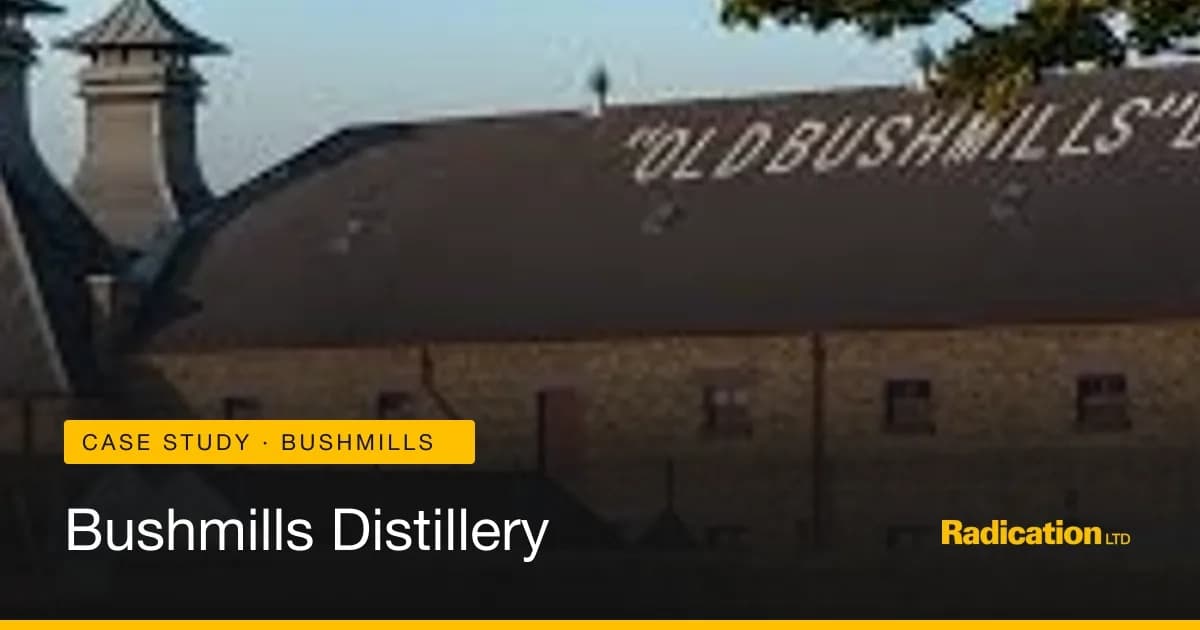
Bushmills Distillery was converting an existing storeroom into a new staff canteen. An architect commissioned us to assess the space before the renovation began — which is the right sequence, and rarer than it should be.
Why a change of use is a damp problem
This is the part worth understanding, because it applies to any conversion.
A storeroom has never needed to be comfortable. It is typically unheated, minimally ventilated, and nobody has had reason to look at it closely for years. Timber and masonry in that kind of space settle into an equilibrium — often damper than you would accept in an occupied room, but stable, and not obviously failing.
Then you convert it. Suddenly the space is heated, which is one of the four conditions dry rot requires. It is occupied, so people generate moisture in it — a canteen especially, with cooking and washing up. It gets sealed and finished, so surfaces that used to breathe are covered over. And it gets fitted out, so anything left in the fabric is now behind new joinery, plasterboard and floor finishes.
A latent problem that was dormant for a decade has, in the space of a fortnight, been given warmth, moisture and cover. That is why conversions surface rot that the building had apparently tolerated indefinitely.
What we found
Our survey identified a number of issues with respect to damp and rot.
That is entirely typical for a storeroom being repurposed. A space that has never needed to be dry usually is not, and the absence of complaints is not evidence of absence — nobody complains about a damp storeroom, because nobody sits in it.
We submitted our findings along with costed recommendations, and the client approved them.
What we did
We completed all of the recommended treatment within a three-month window, which allowed the wider renovation to proceed on schedule. The client was delighted with the final outcome.
The programme mattered as much as the work here. On a commercial project the specialist treatment sits between demolition and fit-out — get it wrong and every trade behind you slips. Fungicidal treatment also needs curing time before finishes go on, and the damp work has to happen before anything is boxed in. That sequencing is agreed at the start, not negotiated mid-contract.
Working in an operating building
A distillery does not stop for a canteen. Our treatments are low odour, water-based and non-flammable, which is not a marketing point in that setting — it is the difference between being allowed on site and not. Solvent-carried products of the sort the industry used decades ago would have brought both odour and fire-risk considerations into a working production environment.
It also means the surrounding building stays in use while the work proceeds, rather than being handed over for a period.
The commercial case for surveying first
Converting a storeroom into an occupied room changes everything about how moisture behaves in it. Finding that before the fit-out goes in costs a survey. Finding it afterwards costs the fit-out.
Put concretely, the difference is:
Found in survey: treatment is a line item in the programme, sequenced between demolition and fit-out. No disruption, no delay.
Found after handover: new finishes come out, the space is out of use, trades return, and the treatment now has to work around joinery that was not there when it was specified.
The survey is the cheapest part of the whole exercise, and it is free.
If you are converting a space
Survey before demolition, not after fit-out. Everything downstream is cheaper.
Assume an unheated space is damper than it looks. Absence of visible damage means nobody has looked behind the finishes.
Plan the ventilation for the new use, not the old one. A canteen, kitchen or shower room generates far more moisture than a store. Without ventilation designed for that, you will have condensation within a season, and it will look like the damp work failed.
Get the cause in writing. Treatment without a stated cause is treating a symptom.
Sequence the specialist work. Fungicidal treatment needs curing time before finishes. Build it into the programme.
Check the contractor is accredited. We are Property Care Association members and TrustMark registered, working to a written specification alongside the project's architects and engineers — see our accreditations.
Project details
Building | Working distillery, staff canteen conversion |
Location | Bushmills, County Antrim |
Work completed | 2020, within a three-month programme |
Services |
We work with architects, contractors and building owners on commercial property across Northern Ireland — listed buildings, schools, hospitals, churches and offices. See our work at First Ballymena Presbyterian Church and Dobbins Inn, Carrickfergus, what we see on the north coast, or ring 028 9061 8343.