
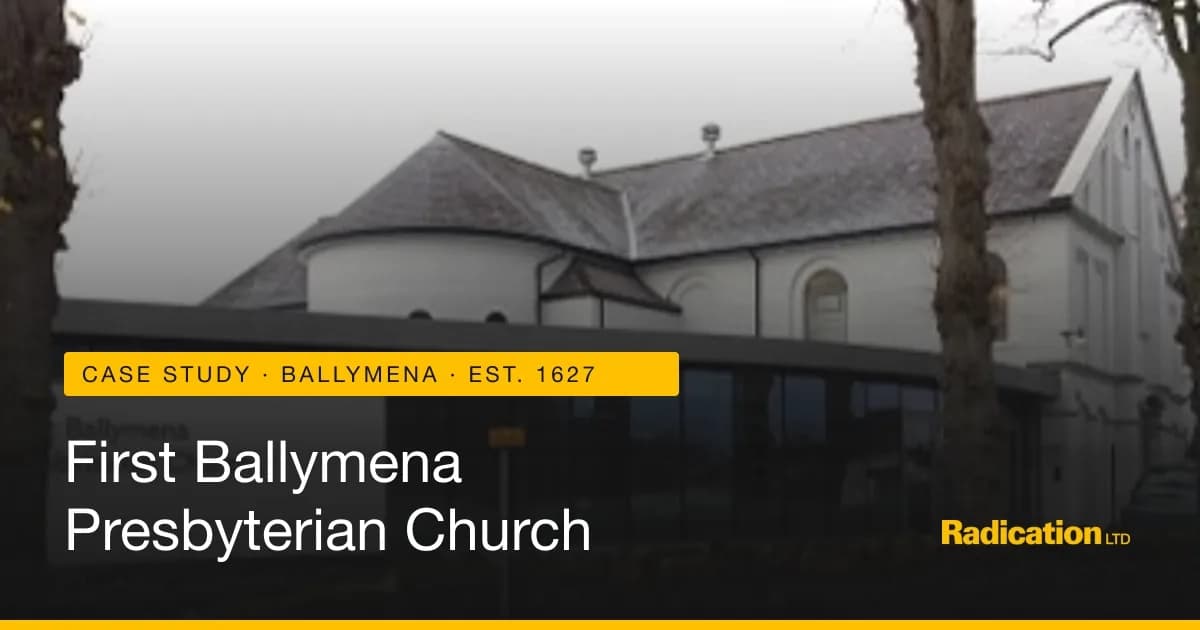
A church established in 1627 has stood for four centuries because generations of people looked after it. When one is about to be refurbished and extended, the order of work matters enormously — and the project architect at First Ballymena Presbyterian Church understood that, which is why we were asked in before construction started rather than after.
Why the architect called us first
Finding active infestation once the builders are on site is expensive and disruptive. Scaffolding is up, trades are booked, and a discovery in the roof structure stops everything.
Worse, refurbishment itself changes the conditions inside a building. Heating a space that was previously cool, sealing draughts, insulating a roof void, laying a new floor over an old one — all of it alters how moisture behaves in the fabric. Timber that has been stable for decades at a given moisture content can start to move in the wrong direction once the building's environment changes.
So a pre-construction survey answers two questions: what is happening now, and what will the refurbishment make happen.
What we surveyed
We carried out an extensive survey of the interior of the main church building, covering:
the ground floor flooring timbers
the gallery
the roof timbers
Those three areas are chosen deliberately, because they are where problems hide in a building of this type.
Roof timbers are the single most under-inspected structural element in any large building. Nobody goes up there. Beetle attack and fungal decay can develop for years, and by the time damage shows on a ceiling below, the structural timber has usually been under attack for a long time.
Gallery structures carry significant live loads and often rest on bearings built into masonry — a classic location for decay, because the timber end sits in a wall where moisture can reach it and air cannot.
Ground floor timbers in a building of this age are typically suspended over a void that depends entirely on cross-ventilation through airbricks. Those get blocked, obstructed by later work, or buried by raised ground levels outside, and the void stops breathing.
What we specified
Our recommendations covered woodworm treatment, dry rot treatment and damp proofing. The client accepted the specification and we completed all of the recommended work.
Three problems in one building is not unusual, and they are related rather than coincidental. Damp timber sustains wood boring beetles. Damp, unventilated timber sustains dry rot. Deal with the beetles and the fungus but leave the moisture, and you will be back.
That is why the damp proofing was part of the same specification rather than a separate consideration. The moisture is the cause; the beetle and the fungus are symptoms.
Why historic buildings need a specification, not a guess
Treatment on a listed or historic building has to work with the construction rather than against it.
Solid stone walls built with lime mortar are designed to breathe. Moisture enters, moves through the fabric and evaporates. That is not a defect; it is how the wall was intended to function. Modern impermeable repairs — cement render, plastic paints, sealants — trap that moisture inside the wall instead. The result is usually worse than the original problem, and in a historic building the damage can be permanent.
Where a building is listed, that principle is not just good practice — alterations need consent from the Historic Environment Division, and a specification that proposes stripping out original fabric may not get it.
The other principle is minimum intervention. Original timber is not a consumable. Sound wood with old, dormant beetle holes generally does not need replacing, and a specification that strips out historic fabric because it looks damaged is destroying the thing it was hired to protect. Our approach is to establish what is structurally compromised, retain what is not, and treat the remainder against further attack.
As Property Care Association members and a TrustMark registered firm we work to a written specification, alongside the project's architects and engineers where required — our accreditations set out what that covers. On a building like this that document matters as much as the treatment — it is what protects the building, and the client, from well-meaning but damaging repairs.
If you look after a church, hall or listed building
A few things worth acting on, from this job and others like it:
Get into the roof space annually. Take a torch. You are looking for fresh, pale-edged exit holes, loose powdery frass beneath them, white mycelium growth, and any musty smell. Our guide on telling active woodworm from old damage covers what to look for.
Survey before the refurbishment, not during it. The cost difference between finding a problem in a survey and finding it mid-contract is considerable.
Check the airbricks and the ground levels. Blocked ventilation under a timber floor is the most common avoidable cause of decay in buildings of this age.
Be sceptical of impermeable repairs. If a contractor proposes cement render or sealing paint on a solid lime-mortared wall, ask how the wall is then expected to dry.
Ask for the cause in writing, not just the treatment. A report that specifies work without explaining why the timber was damp has skipped the part that determines whether the repair lasts.
Project details
Building | Historic church, established 1627 |
Location | Ballymena, County Antrim |
Work completed | 2020 |
Services | Woodworm treatment, wet and dry rot treatment, rising damp control |
We have treated churches, halls and listed buildings across the province since 1967. See our other work at Bushmills Distillery and Dobbins Inn, Carrickfergus, what we do in Ballymena, or ring 028 9061 8343 to arrange a survey.