
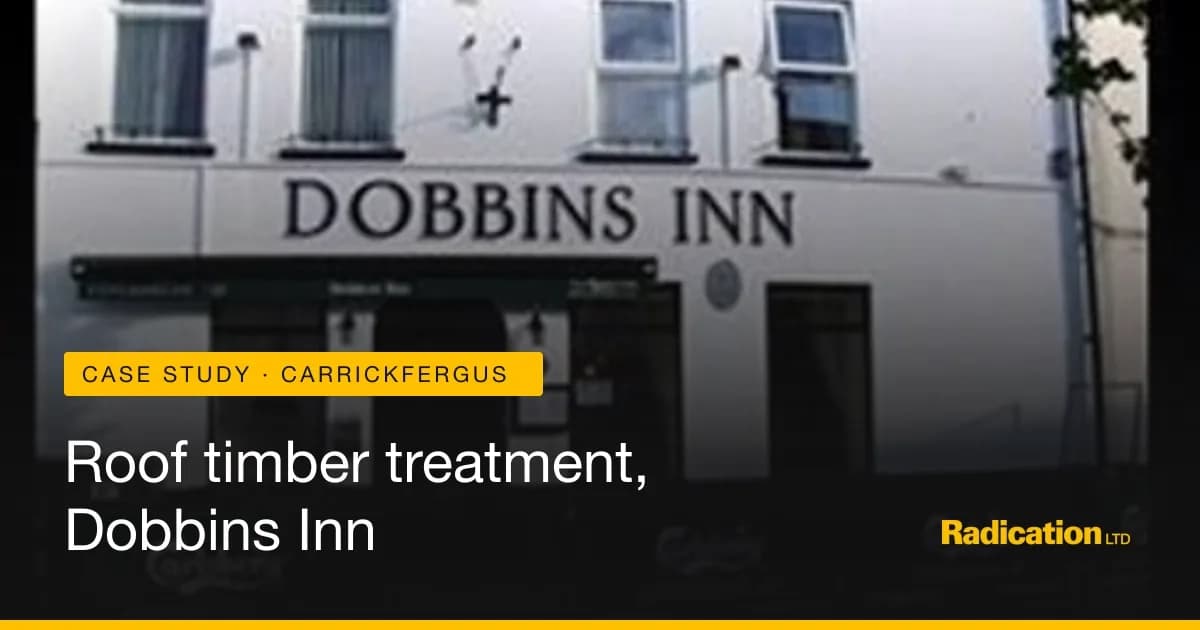
Dobbins Inn has a unique legacy spanning at least 800 years and sits at the heart of the Carrickfergus community. Buildings of that age carry original timber that has survived precisely because generations of people looked after it — and the job of anyone working on them is to be one of those generations, not the one that got it wrong.
Why old roof timber is the hardest case
Three things make a roof structure of this age different from a modern one.
It is out of sight and out of mind. Nobody goes into a roof void without a reason. Beetle attack can run for years before anything shows on a ceiling below, and in a building that has been extended and altered repeatedly over centuries, there may be voids nobody has looked into in living memory.
The timber is irreplaceable. A modern joist is a commodity. A hand-cut historic roof member is not — it carries the building's history, and in many cases its removal needs consent from the Historic Environment Division. Replacing it is both a loss and, often, a bigger job than treating it.
The construction wants to breathe. Buildings of this era are built of solid masonry with lime mortar, designed to absorb and release moisture. Timber built into those walls sits in a fabric that is damp by design. That is fine while it is ventilated, and becomes a problem the moment someone seals it up with impermeable render, modern paint or over-enthusiastic insulation.
What we did
We carried out insecticidal treatment to the roof timbers, using our low-odour, water-based microemulsion insecticide.
The choice of product was driven by the building being open and occupied. Dobbins Inn is a working inn at the centre of the town, not an empty shell handed over for a fortnight. Our treatment is non-flammable and low odour, so the building stayed in use throughout. Solvent-carried treatments of the kind the industry used decades ago would have meant closing, along with a fire-risk assessment nobody wants in a historic timber roof.
The chemicals kill the beetles already active in the wood and penetrate the surface to protect it against reinfestation. If you want the detail on why we favour a microemulsion, and where boron is the better answer instead, we cover that in boron or microemulsion.
Minimum intervention, deliberately
The aim with a building like this is to do the least necessary to stop the attack and preserve the wood against further infestation — not to replace what can be saved. Original timber is not a consumable.
In practice that principle means:
Old holes are not a reason to remove timber. Dormant damage from decades ago needs nothing. Establishing whether attack is active is the whole question — see is my woodworm still active.
Structural judgement, not cosmetic judgement. Timber that looks chewed may still be perfectly sound in section. Timber that looks fine may be hollow at a bearing. That is a survey question.
Treat and retain in preference to strip and replace. Replacement is the last resort, not the default.
Properties we treated three decades ago have been reinspected since and show no signs of the woodworm returning, which is the real test of whether a treatment was adequate.
If you look after an old building in a town centre
Get into the roof space once a year. Torch, ten minutes. Fresh pale-edged holes, loose powdery frass, white growth, musty smell.
Do not seal a breathing building. Cement render and impermeable paint on lime-mortared masonry traps moisture and creates the conditions for dry rot.
Check the ventilation after any works. New windows, new insulation and blocked airbricks are the three most common accidental causes of decay in old buildings.
Ask about disruption before you ask about price. For a building that has to stay open, a low-odour non-flammable treatment is not a luxury.
Insist on retention over replacement, and ask the contractor to justify anything they propose removing.
Check the contractor is accredited. We are Property Care Association members and TrustMark registered, which means the work is carried out to a written specification, developed alongside architects and engineers where the project calls for it. Our accreditations set out what that covers.
Project details
Building | Historic inn, roughly 800 years of history |
Location | Carrickfergus, County Antrim |
Work completed | 2020 |
Services |
We have treated timber in historic buildings across Northern Ireland since 1967. See our work at First Ballymena Presbyterian Church and Bushmills Distillery, what we see in Carrickfergus, or ring 028 9061 8343 to arrange a survey.